

Key Findings
- Citywide rat complaints fell 22% from January to July 2026 versus the same period in 2025, according to DSNY.
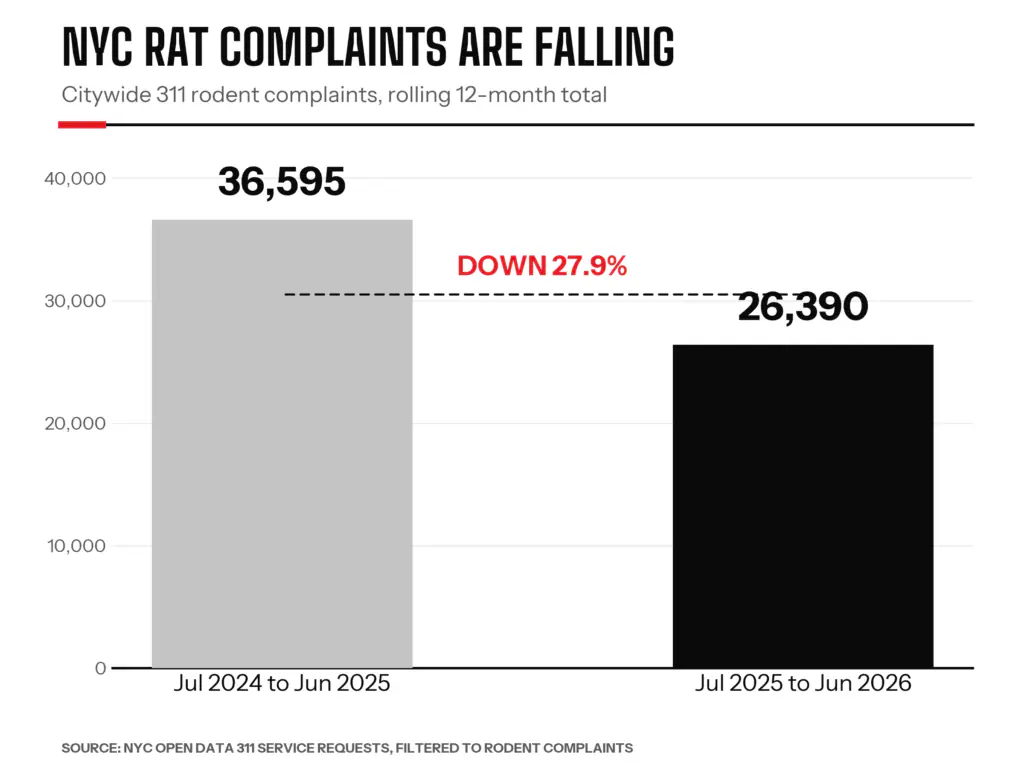
- On a rolling 12-month basis, a more apples-to-apples comparison, complaints fell 27.9 %, from 36,595 (July 2024 to June 2025) to 26,390 (July 2025 to June 2026).
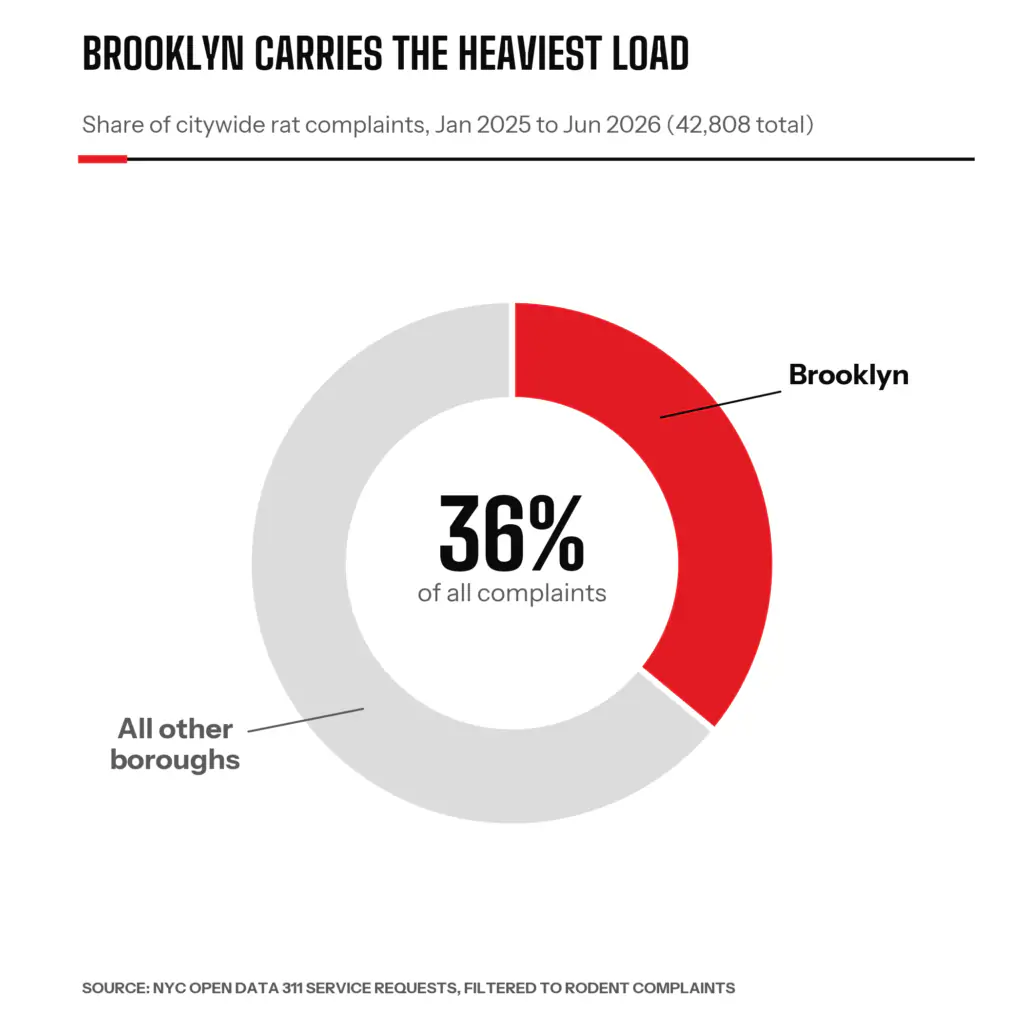
- Brooklyn recorded 36% of the 42,808 complaints filed in the wider study window, the largest share of any borough.
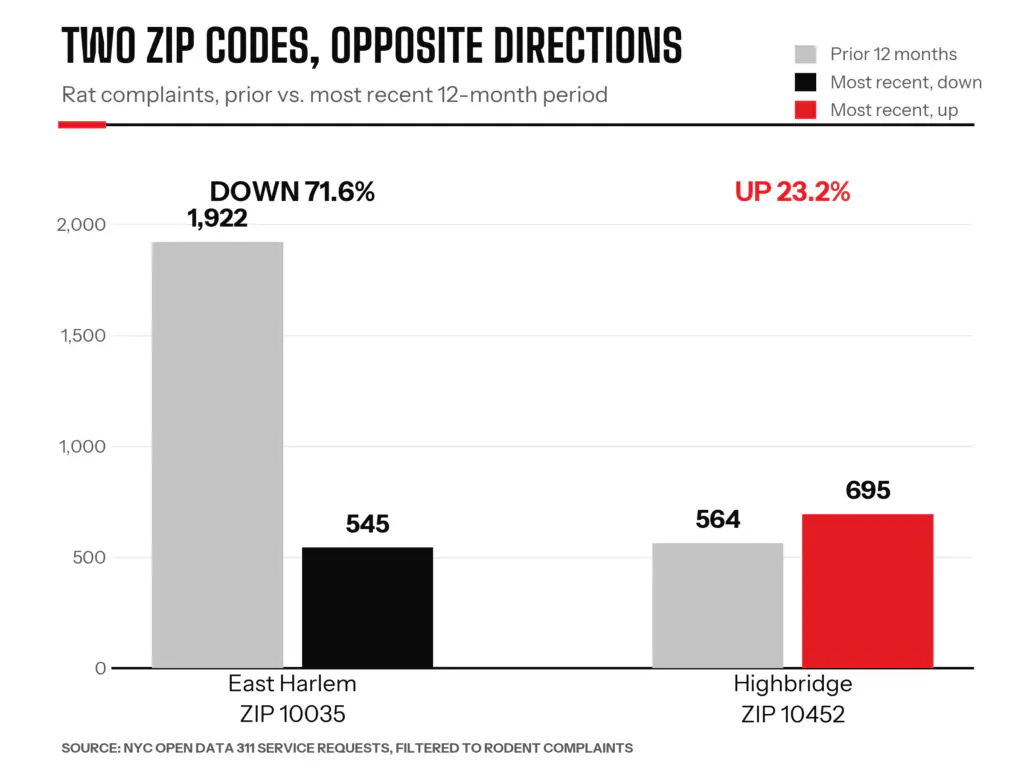
- East Harlem’s ZIP code 10035 had the most complaints of any ZIP code across the full study period, but it is no longer the city’s worst ZIP right now. It fell 71.6 % in the most recent 12 months and dropped out of the citywide top five.
- The new leader is Highbridge in the Bronx, ZIP 10452, where complaints rose 23.2 %. Highbridge is not one of the neighborhoods currently scheduled to get bins by 2027.
- Only one of the city’s 59 community districts, Manhattan’s CD9, is fully containerized right now.
Mayor Zohran Mamdani’s office says the city’s trash containerization push is working. Citywide 311 complaints about rats dropped 22% between January and July 2026, compared with the same period in 2025, according to DSNY Commissioner Gregory Anderson. Officials point to one cause: trash is finally moving out of black bags and into sealed containers.
What isn’t reported is that the city’s own numbers tell a different story “beneath” the headline. The containerization timeline meant to fix it extends to 2031 for most neighborhoods.
The Headline Number, and What Backs It Up
DSNY’s 22% figure covers January 1 through July 31, 2026, compared with the same seven months in 2025. Commissioner Anderson cited it in an August 2026 interview.
In the most recent full rolling 12-month period, July 2025 through June 2026, citywide 311 rodent complaints fell from 36,595 to 26,390, a decline of 27.9%. Every borough declined on this basis. Manhattan fell fastest, down 34%, while Brooklyn remains the largest source of complaints by raw volume even after a 27.5% drop.
The Story Underneath: East Harlem’s Rat Problem Didn’t Disappear, It Moved
For years, ZIP code 10035 in East Harlem was the “rattiest” address in New York City. Across the full study window used for this piece, January 2025 through June 2026, it still holds that title with 1,463 total complaints, more than any other ZIP.
But look at the most recent 12 months, and a different picture appears. East Harlem’s complaints collapsed 71.6 %, from 1,922 in the prior 12-month period to 545, and it dropped out of the citywide top five entirely.
East Harlem sits inside a designated Rat Mitigation Zone, where the city has concentrated extra containerization and enforcement resources, which lines up with the timing of the drop.
The new citywide leader is Highbridge, in the Bronx, ZIP code 10452. Complaints there rose 23.2%, from 564 to 695, in the same 12-month window when East Harlem fell. Highbridge is not one of the six Bronx neighborhoods currently scheduled to receive Empire Bins by 2027. That list covers Hunts Point, Longwood, University Heights, Mount Hope, Morris Heights, and Fordham Heights, none of which is Highbridge.
To be careful here: 311 complaint data measures where rats get reported, not where they live. A drop in one ZIP and a rise in another could reflect actual rat movement, differences in resident reporting habits, or both.
But if containerization resources keep following the same list of announced neighborhoods, Highbridge is currently outside that plan even as its numbers move in the wrong direction.
Where the Rollout Stands
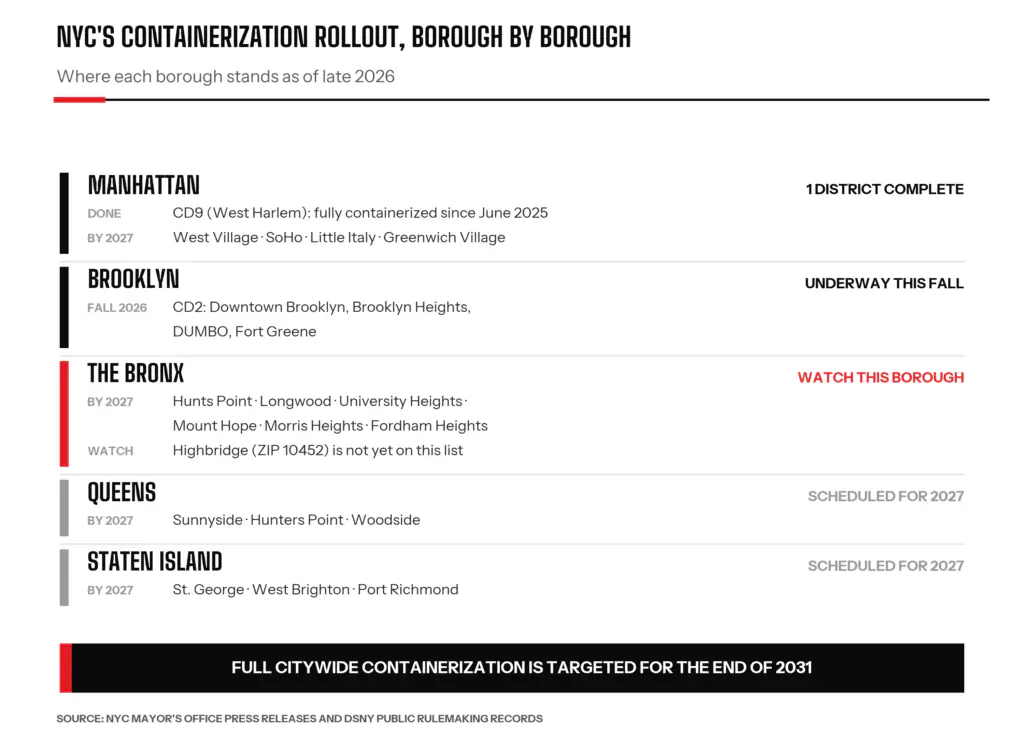
Marking his 100th day in office, Mayor Mamdani committed to a specific schedule: at least one fully containerized community district in every borough by the end of 2027, and full citywide containerization by the end of 2031.
Manhattan. Community District 9, West Harlem, has been fully containerized since June 2025, the only district in the city where the rollout is complete. A separate DSNY rulemaking sets October 18, 2026, as the implementation date for medium-sized buildings in that district that have not opted into on-street containers. Four more Manhattan neighborhoods, the West Village, SoHo, Little Italy, and Greenwich Village, are slated for bins by the end of 2027.
Brooklyn. Community District 2, covering Downtown Brooklyn, Brooklyn Heights, DUMBO, and Fort Greene, is scheduled to receive Empire Bins this fall, meaning rollout begins now.
The Bronx. Hunts Point, Longwood, University Heights, Mount Hope, Morris Heights, and Fordham Heights are scheduled for bins by the end of 2027. Highbridge, the borough’s fastest-rising complaint ZIP, is not on this list.
Queens. Sunnyside, Hunters Point, and Woodside are named for the 2027 rollout.
Staten Island. St. George, West Brighton, and Port Richmond round out the 2027 list.
More than 6,500 curbside Empire Bins are expected across the Bronx, Manhattan, Queens, and Staten Island by the end of 2027. Buildings with 30 or more units will eventually be required to switch over. Smaller buildings can opt in earlier but are not required to yet.
What Businesses Already Have to Do, Regardless of the Timeline
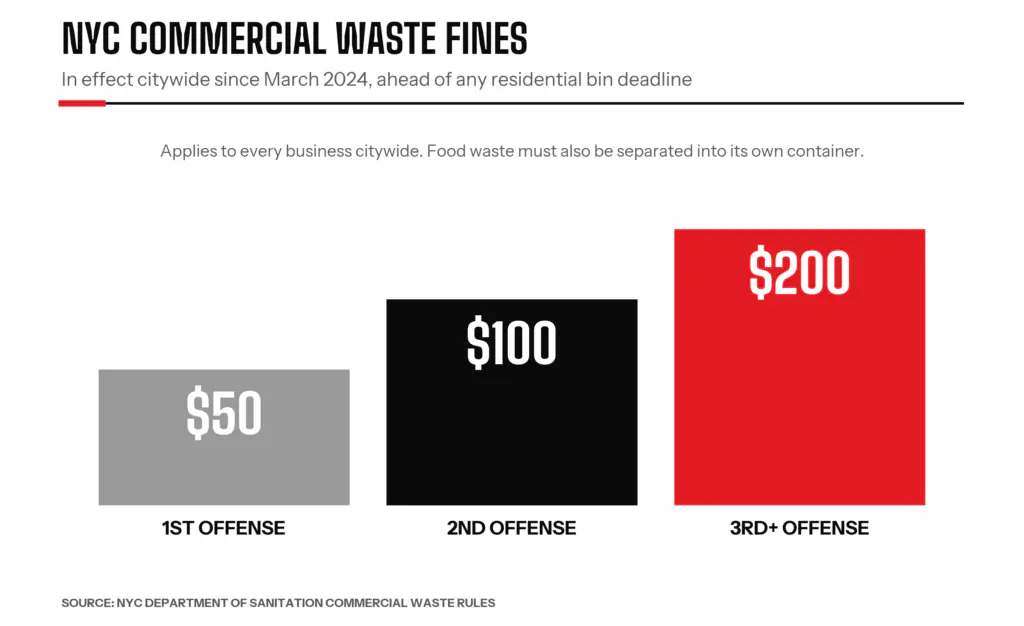
None of the residential deadlines above apply to commercial waste. Businesses citywide have been required to put trash in secured containers since March 2024, more than two years ahead of any residential bin date. Restaurants, offices, and retail spaces must also separate food waste into its own container.
Fines follow a simple structure: $50 for a first offense, $100 for a second, and $200 for every offense after that. A restaurant or office still setting bags directly on the curb is already out of compliance today.
The Rollout Isn’t Without Friction
The program has some real critics. The National Waste and Recycling Association sued the city over commercial waste zone rules, arguing compliance costs could top $33 million per zone.
A report from former Comptroller Brad Lander flagged questions about how DSNY selected zone carters, and one awardee, Cogent, received a notice of violation covering nearly 5,000 counts. Funding for the residential rollout is also still unclear.
The mayor’s office has not said publicly how it will pay for the trucks and bins needed to hit the 2031 date.
What to Do Before Your District’s Bin Day Arrives
- Confirm current bins meet DSNY’s rigid, tight-lid standard, not just any covered container.
- Make sure food waste goes into a separate, properly labeled container.
- If a building has 30 or more units, start budgeting for the eventual switch to city-approved bins well before the district’s official date.
- Track the specific community district timeline. A neighborhood scheduled for 2027 can still see enforcement changes earlier, like the October 2026 date already set for Manhattan CD9.
- In ZIP codes with rising complaints that aren’t yet on a rollout list, don’t assume bins are coming soon. Ask what interim options, like scheduled pickup adjustments, are available now.
Opura works inside offices, restaurants, and commercial spaces across New York City, Nassau County, and Northern New Jersey, which means keeping clients ahead of DSNY’s containerization and food waste rules is already part of the job. Businesses that want a walkthrough of where their current setup stands can reach out for a custom plan.
Data and Methodology
This piece draws on two different kinds of sources, and they should not be treated the same way.
Official city figures.
DSNY Commissioner Gregory Anderson stated the 22% decline (January to July 2026 versus January to July 2025) in an August 2026 interview with CBS New York. This is an on-the-record city statistic, not a published dataset. DSNY has not released the underlying complaint counts for that specific seven-month comparison, so we could not independently verify the raw numbers or confirm whether it removed duplicate complaints before calculating this figure.
The containerization schedule, district names, and implementation dates in this piece come directly from NYC Mayor’s Office press releases and DSNY’s public rulemaking record, both primary sources with no third party involved.
The 311 dataset.
Exact windows used: cumulative study period, January 1, 2025 to June 25, 2026 (42,808 total complaints). Rolling 12-month comparison: July 1, 2025 to June 30, 2026 (26,390 complaints) versus July 1, 2024 to June 30, 2025 (36,595 complaints).
Any journalist or researcher can reproduce or check these figures directly through the NYC Open Data 311 Service Requests dataset by filtering complaint_type to Rodent and setting the date range above.
Sources: NYC Mayor’s Office, DSNY public rulemaking records, CBS New York, Streetsblog NYC, Waste Dive, NYC Open Data, and NYC Rodent Report’s published analysis of NYC Open Data 311 records.